Definitions, images and pronunciation for almost everything in celestial bodies, astronomical observations and astronautics.

The Universe, the galaxies, the stars, the Solar System, and more.

Google Earth Tour that describes the landing, moon walks, and the return to space of Apollo 11 with excellent visual aids and great narrations.

The Apollo missions on the Wikipedia.
Don't forget to check the links to the Apollo 11 and Apollo 13 missions.

The International Space Station turns 10.
A great collection of 32 high quality photos of the IIS, compiled for its tenth birthday.

Nine maps, the first one showing the nearest stars. The others slowly expand out until we have reached the scale of the entire visible Universe.

A classic movie that shows the amazingly huge size of the Universe parting from a small square one metre long.

Hubble Space Telescope Advent Calendar 2008.
A collection of 25 high quality photos of the Universe from the amazing Hubble Space Telescope.

Hubble Space Telescope Advent Calendar 2009.
25 commented photographs, some old, some new, to celebrate the traditional western Christmas Season.

Hubble Space Telescope Advent Calendar 2010.
Third annual Hubble Space Telescope imagery Advent Calendar, with 25 new stunning photos.

Hubble telescope favorite images.
Some of the most important and famous images taken by the Hubble explained in detail. Visiting this site is a must.
Ongoing project that features a high resolution sky map with celestial objects that are outside our solar system mapped out.

First Images from the James Webb Space Telescope.
After years of delays, in July 2022 we are finally seeing the sharpest images of the Universe taken by the most powerful telescope ever deployed.

Simulated planetarium that allows you to observe stars, constellations and planets from any specific location on Earth.

360-degree panoramic image, covering the whole of the vault of heaven.

Earth may soon have a second sun.
The red supergiant star Betelgeuse is getting ready to go supernova, and when it does Earth will have a front-row seat.
Fly around the Solar System's planets and explore the constellations in 3D and real time with this excellent interactive model.

Wikipedia's Wikijunior online book on the Solar System. Comprehensive, aimed to kids, but still unfinished.

Wikipedia's article on the Solar System. Very up to date.

NASA: Solar System exploration.
Full information on the Solar System offered by the scientists from the NASA.

Collected here are 32 images gathered from around our solar system, at scales ranging from mere centimeters to millions of kilometers.

Catalog of spaceborne imaging.
Images of the Solar System bodies taken by the NASA missions.

Ten mysteries of the Solar System.
Some of the most intriguing facts in our stellar system.

Sun's structure, energy and influence on the Earth.

Beautiful photo taken by astrophotographer Alan Friedman that shows sunspots, giant convection cells and prominences silhouetted against the sky.

A collection of some of the most amazing photos ever taken of our star.

Amazing animation showing the movements of the planets from different perspectives.
Sensational images of Saturn showing the ringed planet in incredible detail.

The Big Picture: Saturn at equinox.
During the equinox, the sunlight casts long shadows across Saturn's rings, highlighting previously known phenomena and revealing a few never-before seen images.

The Big Picture: Martian skies.
A wonderful selection of some of the best martian images ever made.

Landing on Mars is an inevitability. This website simulates a tour through the Martian landscape and a human colonized habitat. The walkthrough is a lesson in the science, technology, and design challenges that will be required to land man on the Red Planet.
Want to know how the Earth looks like right now?

The Seasons in Geography4kids.
Learn how the relative position of the Earth to the Sun conditions the climate and the daylength.

Ten things you don't know about the Earth.
Fantastic article that unravels some of the most significant facts about our planet... or did you already know that the Everest is not the biggest mountain?

Gravity satellite yields 'Potato Earth' view.
The geoid is the Earth depicted according to the gravty of its surface. ESA's GOCE satellite shows it with an unprecedented accuracy.

June 19, 240 B.C.: the Earth is round, and it's this big.
Those were the great news more than 2,200 years ago. They took a time to spread around the globe, though.

If you are interested in the Moon or the Apollo landings, Google currently has a wonderful educational tool regarding the Moon that will interest everyone.
Videos, images and lots of info to learn almost everything about our only natural satellite.

Images of the Moon taken by the NASA missions.

Huge panoramic picture of the Moon (I).
Taken by the Apollo 12 crew, in the second manned mission to the Moon ever.

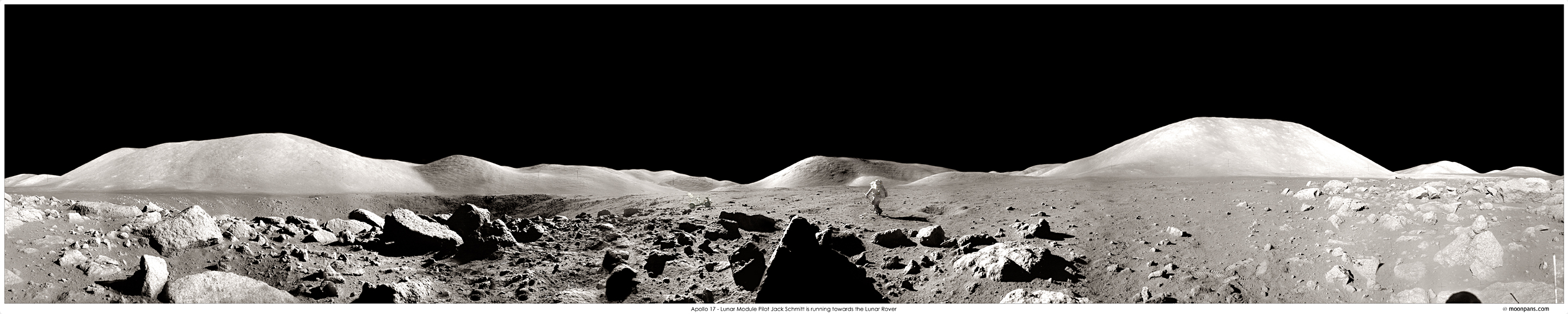
Huge panoramic picture of the Moon (II).
Taken by the Apollo 17 crew just a few days before the man left the Moon for the last time.